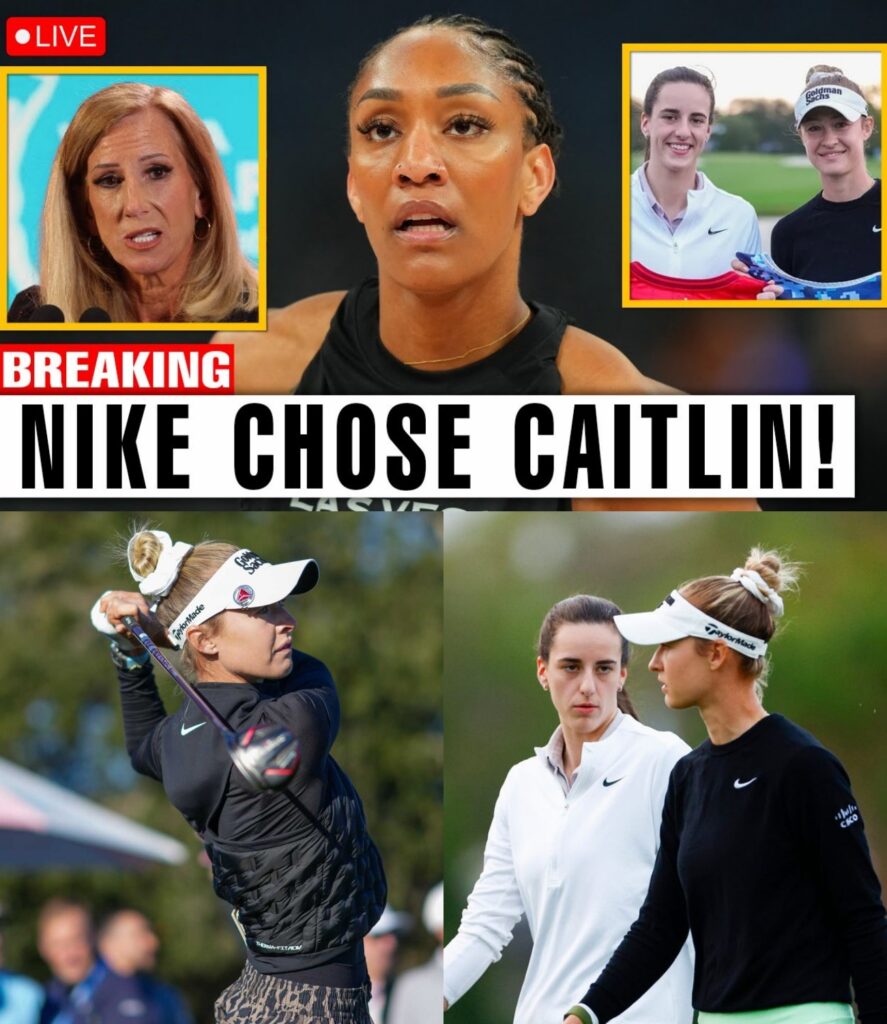
A marketing earthquake just hit women’s sports, and its shockwaves are rattling the very foundation of the WNBA. Nike’s newest power play — a high-profile, cross-sport activation featuring Caitlin Clark and golf superstar Nelly Korda — is more than a viral moment.
It’s a message.
A strategy.
And to many inside the league, a provocation.
While A’ja Wilson continues stacking MVPs, trophies, and historic seasons, Nike has made its choice clear: the next era of women’s sports will be built around marketability, not résumé.
And at the center of that empire?
Caitlin Clark.
The Viral Moment Wasn’t an Accident — It Was a Signal
Nike didn’t just pair two of the most talked-about female athletes in the world for fun. This wasn’t a last-minute creative decision or a coincidental partnership.
This was deliberate brand architecture.
Two things became obvious the second the campaign dropped:
- Nike wants Clark to be a global face, not just a basketball star.
- Cross-sport crossovers = cross-market dominance.
By connecting Clark with Korda — a reigning major champion, Olympic gold medalist, and one of the most recognizable athletes in golf — Nike expanded Clark’s reach into:
- golf audiences
- lifestyle markets
- international fanbases
- fashion and luxury demographics
For Nike, this is how you build a franchise athlete.
For the WNBA establishment, this is how you create a divide.
Why the “Old Guard” Is Furious
Veterans in the league aren’t confused — they understand exactly what just happened.
For years, the WNBA hierarchy was simple:
- Earn your stripes
- Win your awards
- Dominate the league
- Then get the big marketing deals
But now?
That formula is gone.
Caitlin Clark skipped the line — not through favoritism, but through unprecedented cultural impact.
And that’s where the tension comes from.
A’ja Wilson has achieved everything players are told they must do to become superstars:
✔ MVPs
✔ Championships
✔ Defensive dominance
✔ All-time-level production
Yet Nike is prioritizing a rookie with zero professional accolades… because she can move culture on command.
That stings — and players are saying the quiet part out loud more often each week.
“Merit vs. Marketability”: The New Battle Line
The league is entering a new phase.
A reality that many didn’t want to face is now unavoidable:
Popularity pays.
Visibility equals value.
Marketability wins battles that stats can’t.
Nike isn’t betraying anyone — they’re following the data.
Clark sells out arenas.
Clark breaks TV records.
Clark moves merchandise before she even touches the court.
Clark has a fanbase that rivals entire franchises.
Whether the establishment likes it or not, she is the first women’s basketball player in decades whose relevance transcends her sport.
That is the “chosen one” energy Nike is investing in.
The Business Behind the Backlash
To fans, it’s just a campaign.
To athletes, it’s just a pairing.
To Nike, it’s a billion-dollar strategy.
But to insiders in the WNBA?
It feels like a shift in power — and possibly a betrayal of the veterans who built the league brick by brick.
If Clark becomes the face of women’s sports globally, she changes:
- salaries
- sponsorship structures
- league priorities
- media coverage
- brand hierarchies
Some see that as evolution.
Others see it as erasure.
And that’s why tensions are rising.
The New Reality: Caitlin Clark Isn’t Competing With the WNBA — She’s Expanding the World Beyond It
Nike understands something the WNBA is just beginning to accept:
The future belongs to athletes who can command attention across sports, continents, and cultures.
Clark has that ability.
Korda has that ability.
Together, they represent a playbook built for the next decade.
Whether the veterans embrace that shift or resist it…
the transition has already begun.
