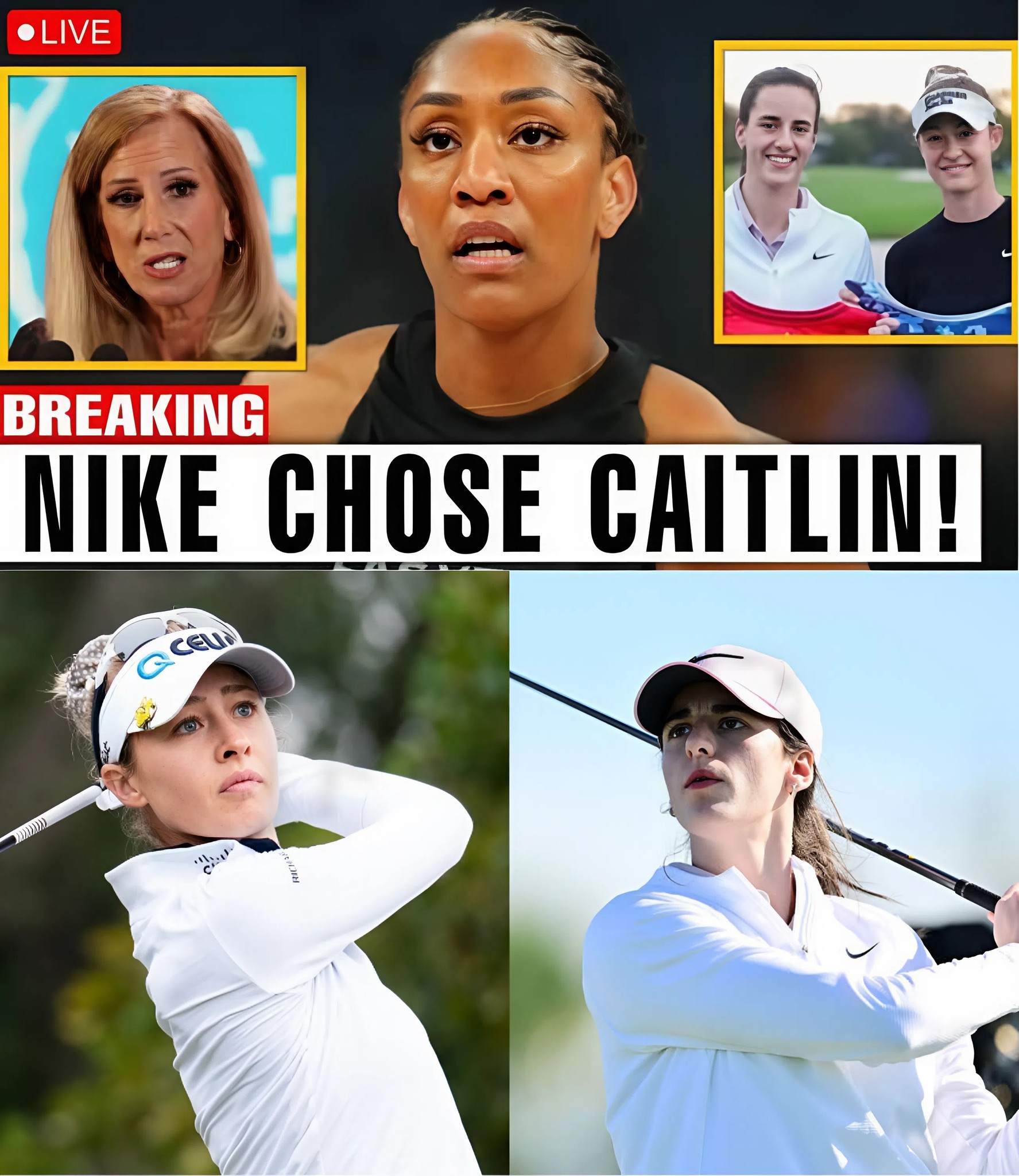
Why the Caitlin Clark–Nelly Korda partnership has the league’s establishment fuming
The WNBA woke up to a shockwave this week — not because of a trade, not because of an upset, but because of a marketing message.
A single, polished, cross-sport moment featuring Caitlin Clark and golf superstar Nelly Korda has sparked a firestorm inside the league and among fans.
To many veterans, this wasn’t just a fun collaboration.
It was a signal.
A loud one.
Nike has made its move… and the message is unmistakable:
⭐ *Marketability beats merit.
⭐ Stardom outranks seniority.
⭐ And Caitlin Clark is the new face of everything.*
🔥 A’ja Wilson Dominates the Court — But the Spotlight Goes Elsewhere
No one in the WNBA has done more in recent years than A’ja Wilson:
- Championships
- MVP campaigns
- Defensive dominance
- The leadership that built a dynasty
By every competitive measure, she is the league’s standard.
And yet — the cultural wave is passing her.
Nike’s latest promotional push makes it clear that the company is not building its future empire around the proven greats…
but around a rookie whose popularity has skyrocketed beyond anything women’s basketball has seen.
This isn’t about fairness — it’s about business.
And for the WNBA establishment, that realization is stinging.
🎯 Why This Moment Hit So Hard
The viral Clark–Korda crossover wasn’t accidental.
It was strategic.
Calculated.
A masterclass in shaping the next global superstar.
Nike effectively declared:
“We aren’t just promoting an athlete — we’re building a brand universe.”
Bringing together two of the most marketable young stars in American sports was a direct statement about where the company believes the most explosive growth will come from.
And for many veterans watching from the sidelines, the message felt brutally clear:
“We built the league.
We carried it through the lean years.
And now we’re being overshadowed by a marketing phenomenon.”
⚡ A Growing Divide Inside the WNBA
Behind the scenes, analysts and insiders say the tension is real — not because athletes resent Clark personally, but because the system is shifting around her.
Veterans feel:
- Their achievements are being minimized
- Their market value is being eclipsed
- Their cultural contributions are being overwritten
- Their loyalty is suddenly less profitable
For players who fought for visibility long before the era of viral highlights, the sudden shift feels like a corporate betrayal.
🏀 A Rookie vs. an Era
This isn’t Caitlin Clark’s fault — she didn’t choose to become the centerpiece of Nike’s newest empire.
But her presence has forced the entire WNBA to confront a new reality:
The business now moves at the speed of attention, not tradition.
And the athletes who don’t fit the new marketing mold — even if they are champions, MVPs, and legends — risk being left behind.
Nike’s Clark-Korda rollout was more than a commercial.
It was a declaration of dominance.
And the veterans heard it loud and clear.
🚨 What Happens Next?
As brands, networks, and sponsors follow Nike’s lead, the divide will grow sharper:
- The “marketability era”
versus - The “merit era”
The WNBA wanted growth.
It got an explosion.
But explosions change landscapes — and not everyone benefits.
And whether fans love or hate this new direction, one thing is certain:
The future of women’s sports will be shaped not only by champions…
but by the chosen faces corporate giants decide to elevate.
