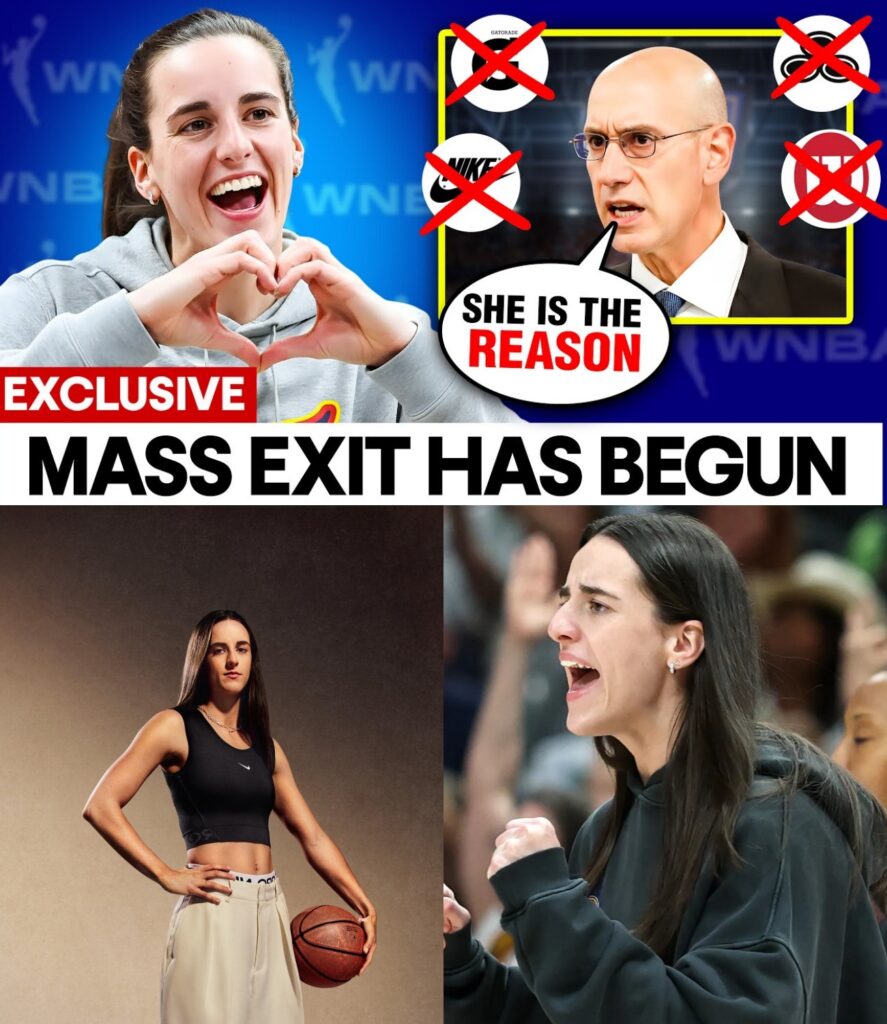
The WNBA believed it was steering the narrative.
It believed it could shape the future of women’s basketball on its own terms.
But then Caitlin Clark arrived — and the entire rulebook evaporated.
In less than a year, the league’s most celebrated rookie has done what no player before her has accomplished: she has become bigger than the system designed to elevate her. And while the WNBA scrambles to reposition its marketing strategy, corporate giants like Nike, Gatorade, and State Farm have wasted no time in crowning Clark the global centerpiece of women’s sports.
This isn’t hype.
This is economics.
And the numbers don’t lie.
The WNBA’s Marketing vs. Corporate America’s Reality
The league tried early on to treat Clark like any other rising star — a promising addition, sure, but one piece in a larger machine.
Brands disagreed immediately.
The moment she declared for the draft, companies moved faster than the league ever could:
- Nike launched a signature-shoe initiative before she even played a game.
- Gatorade rolled out a national campaign centered entirely around her story.
- TV partners shifted schedules to prioritize her broadcasts.
- **Ticket resale markets exploded — not for teams, but for her.
By the time the WNBA attempted to push its own “balanced spotlight” marketing strategy, the world had already answered the question:
Caitlin Clark isn’t part of the WNBA’s promotional plan. She is the promotional plan.
The Caitlin Effect: When One Athlete Becomes an Economy
What separates Clark from every star before her isn’t just popularity — it’s economic gravity. Everything she touches increases in value:
- Attendance skyrockets when she plays.
- TV ratings hit historic highs.
- Merchandise sells at unprecedented speeds.
- Opposing teams break revenue records on her visits alone.
- Streaming platforms hit peak numbers for her games.
No league in the world can ignore an athlete who literally moves markets every time she steps on the court.
The WNBA didn’t expect this.
It didn’t prepare for this.
And now, it’s racing to adapt to something it’s never had to deal with: a player whose influence surpasses the league’s entire marketing infrastructure.
Nike and Gatorade Have Already Declared Their Winner
When Nike and Gatorade decide to build year-long campaigns around an athlete, they’re not just endorsing them — they’re making a long-term investment.
And in Clark’s case, those investments say one thing:
She’s not just the face of the WNBA.
She’s the face of women’s basketball globally.
Nike is designing her like a franchise.
Gatorade is positioning her like a generational icon.
Brands are building an ecosystem around her — fashion, lifestyle, culture, global sport.
This level of corporate backing isn’t just support.
It’s succession planning.
The WNBA Wanted Balance — The World Wanted Clark
The league has tried to distribute attention evenly, uplift veterans, and highlight multiple stars. A noble effort… but impossible to execute in reality.
Clark is a gravitational force.
Fans follow her.
Networks follow her.
Brands follow her.
The economy follows her.
The WNBA can either chase the momentum or lose it — but it can’t control it.
The rookie has changed the rules.
The Truth: The League Didn’t Create the Moment — The Moment Created Caitlin Clark
The WNBA may have drafted her, but the global sports economy adopted her.
She built her own spotlight.
She built her own platform.
And now, she’s building a market so large the league is struggling to keep up.
The “Caitlin Effect” isn’t a storyline — it’s an industry.
And the industry has spoken loudly:
one player has become a movement.
